

The landscape of reproductive medicine has shifted significantly as we enter 2025. While technological breakthroughs in laboratory environments and genetic screening have improved outcomes, the biological reality remains: the IVF success rate by age is the most definitive predictor of a successful pregnancy.
Understanding these statistics is not about discouragement; it is about setting realistic expectations and choosing the right clinical path. Today, roughly 2% of all births in the United States result from assisted reproductive technology (ART), but those successes are distributed differently across age demographics.
When we discuss the IVF success rate by age, we focus on the “live birth rate,” which represents the ultimate goal of bringing a healthy baby home, rather than just achieving a positive pregnancy test.
Why Age is the Primary Factor in IVF Success
Biological aging impacts fertility more than almost any other medical variable. To understand your personal IVF success rate by age, you must understand two things: egg quantity and egg quality. Women are born with a finite number of oocytes, known as their ovarian reserve. As time passes, this reserve naturally diminishes. However, the more pressing issue for IVF is egg quality.
As eggs age, they are more prone to aneuploidy, or chromosomal abnormalities. An embryo created from an aneuploid egg typically fails to implant or results in an early miscarriage. This is why the IVF success rate by age begins a steady decline in the mid-30s and drops more sharply after 40.
Even with the most advanced stimulation protocols, a reproductive endocrinologist cannot “fix” the genetic integrity of an older egg. Consequently, the IVF success rate by age is essentially a measurement of the percentage of chromosomally normal embryos a patient is likely to produce during a single stimulation cycle.
2025 Statistics: Breaking Down IVF Success Rate by Age Groups
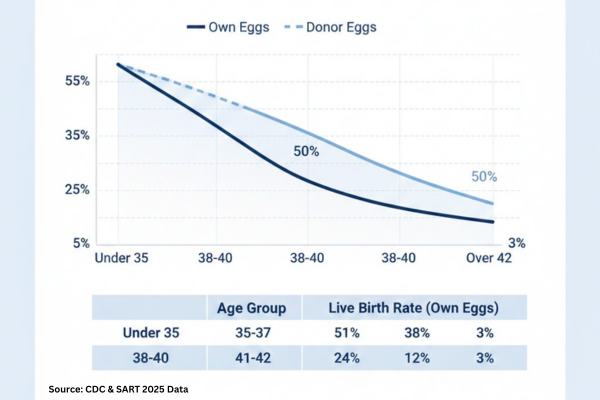
When reviewing the IVF success rate by age, we look at the most recent data provided by the CDC IVF success rates and SART success rates. These organizations track thousands of cycles to provide the following benchmarks for 2025.
Under 35
For patients in this bracket, the IVF success rate by age is at its peak. On average, the IVF live birth rate per single embryo transfer is between 45% and 55%. Because egg quality is generally high, these patients often have surplus embryos to freeze for future siblings.
35–37
The decline begins subtly here. The IVF success rate by age for this group typically ranges from 32% to 40%. Many clinics now recommend PGT-A (Preimplantation Genetic Testing) at this stage to ensure only chromosomally healthy embryos are transferred.
38–40
This is a transitional period. The IVF success rate by age drops to approximately 20% to 26%. While success is still very common, it may take more than one egg retrieval to find a genetically normal embryo.
41–42
The IVF success rate by age for women in their early 40s is roughly 9% to 15% per cycle. At this stage, the “attrition rate” from egg retrieval to the blastocyst stage is high due to the increased frequency of chromosomal shifts.
Over 40? See how our personalized protocols improve these odds. [Inquire Here]
Over 42
The IVF success rate by age using own eggs drops to under 5%. For many in this category, the conversation shifts toward donor oocytes to significantly increase the odds of a healthy delivery.
| Age Group | Live Birth Rate (Own Eggs) | Live Birth Rate (Donor Eggs) |
| Under 35 | 51% | 54% |
| 35-37 | 38% | 54% |
| 38-40 | 24% | 53% |
| 41-42 | 12% | 52% |
| Over 42 | 3% |
51% |
Why Your Personal Results May Differ From These 2025 Averages
While statistics provide a helpful roadmap, they are based on broad national data and do not represent your individual potential for success. At The Life Fertility, we often see patients achieve successful pregnancies even when the general “averages” suggest otherwise.
Here is why your specific outlook is unique:
-
Customized Protocol vs. Standard Care: National statistics often include “standard” IVF cycles. Our 2025 protocols are hyper-personalized, utilizing advanced egg quality support and timing techniques that the general averages don’t account for.
-
Ovarian Reserve & Biological Age: Your “biological age” (the health of your eggs) is often different from your “chronological age.” Factors like AMH levels and antral follicle counts give us a more accurate picture than a simple birth year.
-
Lifestyle & Pre-Cycle Optimization: Statistics don’t measure the impact of personalized nutrition, stress management, and medical priming. We focus on optimizing your body before the cycle begins to tilt the odds in your favor.
-
Technological Advancement (The 2025 Edge): Laboratory techniques, such as ICSI, PGT-A (genetic screening), and advanced incubation systems, have evolved. These tools allow us to overcome barriers that used to lower the success rates in older data sets.
Don’t let the averages discourage you. Our specialists look at the person, not just the age bracket. Your journey is unique, and your treatment plan should be too.
Cumulative Success: Does Your IVF Success Rate by Age Improve with Multiple Cycles?
One of the most misunderstood aspects of fertility treatment is the difference between a single-cycle success rate and the cumulative live birth rate. While the IVF success rate by age for one attempt might seem daunting, the odds improve significantly when you commit to multiple rounds.
Statistics show that for a woman aged 38, her IVF success rate by age might be 25% for the first cycle. However, if she undergoes three cycles, her cumulative chance of having a baby can jump to over 60%. This is because IVF is often a diagnostic process.
The first cycle tells the doctor how your body responds to the medications, allowing them to refine the protocol for the second attempt. Thinking of the IVF success rate by age as a marathon rather than a sprint helps manage the emotional toll of the journey.
Maximizing the IVF Success Rate by Age 40 and Beyond
For those starting the process later in life, the IVF success rate by age 40 can feel like a race against time. However, 2025 protocols offer better tools than ever before. Frozen Embryo Transfer (FET) has become the gold standard, as it allows the woman’s body to recover from the hormones of stimulation before the embryo is introduced to the uterus.
If the IVF success rate by age remains low after multiple attempts with own eggs, donor eggs offer a transformative alternative. Because the success of IVF is tied to the age of the egg donor, a 45-year-old using eggs from a 25-year-old donor can see her IVF success rate by age skyrocket from 2% to over 50%.
Additionally, focusing on uterine health and metabolic wellness can ensure that once a healthy embryo is found, the environment for implantation is optimal.
Beyond Age: Other Factors Impacting Your IVF Odds
While the IVF success rate by age is the primary benchmark, it is not the only one. Other clinical entities play a role in whether a cycle results in a live birth.
-
- Ovarian Reserve Markers: Your AMH levels and Antral Follicle Count (AFC) provide a roadmap of how many eggs the clinic can expect to retrieve.
-
- Lifestyle Factors: High BMI, smoking, and excessive alcohol consumption can suppress the IVF success rate with age by affecting egg maturation.
-
- Male Factor Infertility: Success also depends on the sperm’s ability to fertilize the egg. Modern techniques like ICSI (Intracytoplasmic Sperm Injection) help mitigate this, but sperm DNA fragmentation can still impact the IVF success rate by age.
-
- Clinic Expertise: The “lab factor” is real. Not all clinics have the same success in growing embryos to the blastocyst stage.
Conclusion: Taking the Next Step in Your Fertility Journey
Navigating the IVF success rate by age requires a balance of clinical data and personal resilience. While the statistics provide a map, every patient’s biological profile is unique. The most important step you can take is to consult with a reproductive endocrinologist who can perform a full workup, including AMH testing and an ultrasound, to provide a personalized estimate of your success.