In roughly 50% of couples seeking help with fertility, a male factor is a contributing or primary cause. We understand that navigating these challenges requires both advanced medical science and compassionate support to help you achieve your dream of parenthood.
Key Takeaways
| Topic | Key Information |
|---|---|
| What is Surgical Retrieval? | Procedures like TESA/PESA/TESE extract sperm directly from the reproductive tract. |
| Who needs it? | Men with azoospermia (no sperm in ejaculate) or severe male infertility factors. |
| Success with ICSI | Surgically retrieved sperm is typically used with Intracytoplasmic Sperm Injection (ICSI). |
| Fertility Testing | A comprehensive semen analysis is the first step in diagnosing these conditions. |
| Treatment Paths | Retrieval is often part of a broader IVF procedure and treatment plan. |
What is the best method for sperm retrieval?
The best method depends on the cause of infertility, but Micro-TESE is often preferred for non-obstructive cases in 2026.Can I use frozen sperm for IVF?
Yes, sperm cryopreservation allows for the storage and future use of retrieved samples.
Understanding the Modern Landscape of Male Infertility
We recognize that male infertility is a common but often misunderstood challenge for many couples. In 2026, diagnostic tools will allow us to identify specific causes ranging from hormonal imbalances to physical obstructions. Obstructive azoospermia occurs when sperm is produced but cannot reach the ejaculate due to a blockage. Non-obstructive azoospermia involves a lack of sperm production within the testicles themselves.

Identifying the root cause is essential for determining the most effective fertility intervention. We use specialized screenings to evaluate reproductive health and guide your personalized care journey.
The Necessity of Surgical Sperm Retrieval
Surgical retrieval becomes necessary when viable sperm cannot be obtained through traditional ejaculation. This is a common requirement for men who have undergone a prior vasectomy or have a congenital absence of the vas deferens. Our clinic specializes in these delicate procedures to ensure the highest chance of obtaining healthy sperm. These techniques have revolutionized the treatment of severe male factor infertility.

Without these surgical options, many men would not be able to contribute their own genetic material to a pregnancy. We work closely with our patients to explain why a specific retrieval method is recommended for their situation.
Exploring TESA, PESA, and TESE Procedures
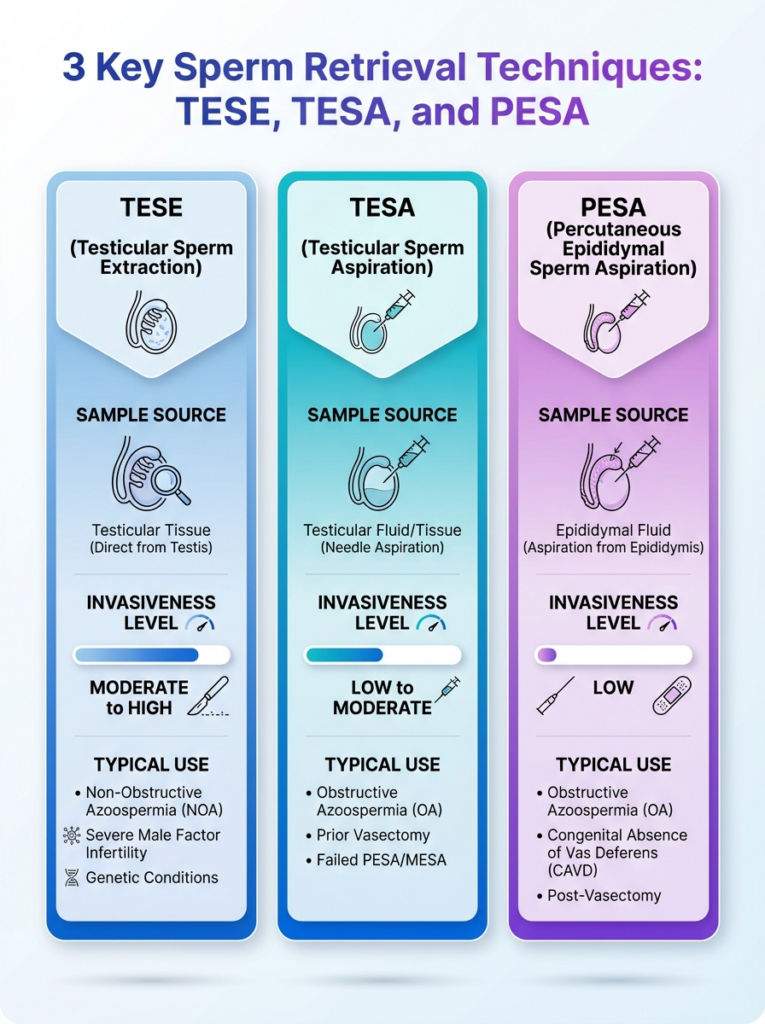
We offer several types of surgical sperm retrieval to suit different clinical needs. Percutaneous Epididymal Sperm Aspiration (PESA) involves using a fine needle to collect sperm from the epididymis. Testicular Sperm Aspiration (TESA) is a similar minimally invasive technique that retrieves sperm directly from the testicular tissue. For more complex cases, Testicular Sperm Extraction (TESE) involves a small tissue biopsy to locate sperm.
Each of these methods is performed under local anesthesia or sedation to ensure your comfort. Our team determines the best approach based on whether the infertility is obstructive or non-obstructive.
The Role of ICSI in Successful Fertilization
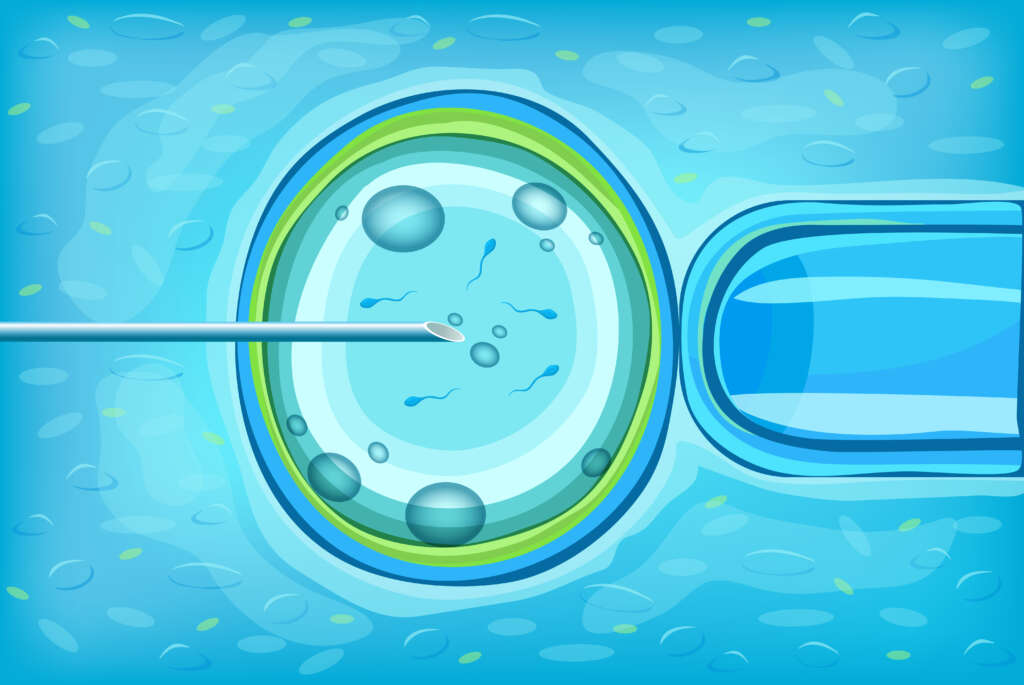
Once sperm is successfully retrieved, it is typically used in conjunction with Intracytoplasmic Sperm Injection (ICSI). This highly specialized technique involves injecting a single, healthy sperm directly into a mature egg. ICSI is particularly effective when working with surgically retrieved sperm, as the quantity of sperm obtained may be limited. This process bypasses the need for sperm to swim to and penetrate the egg on its own.
Did You Know?
In cases of obstructive azoospermia, surgical sperm retrieval is successful in nearly 100% of patients.By using ICSI, we can maximize the chances of fertilization even when only a few viable sperm are present. This method has become the standard of care for surgical retrieval cases in 2026.
Advancements in Microsurgical Extraction (Micro-TESE)
For men with non-obstructive azoospermia, Micro-TESE represents a significant advancement in reproductive technology. This procedure uses a high-powered microscope to identify specific areas of the testicle likely to contain sperm. By being more selective, Micro-TESE can increase retrieval rates while minimizing the amount of tissue removed. We find that this targeted approach is often more successful than conventional TESE for many patients.
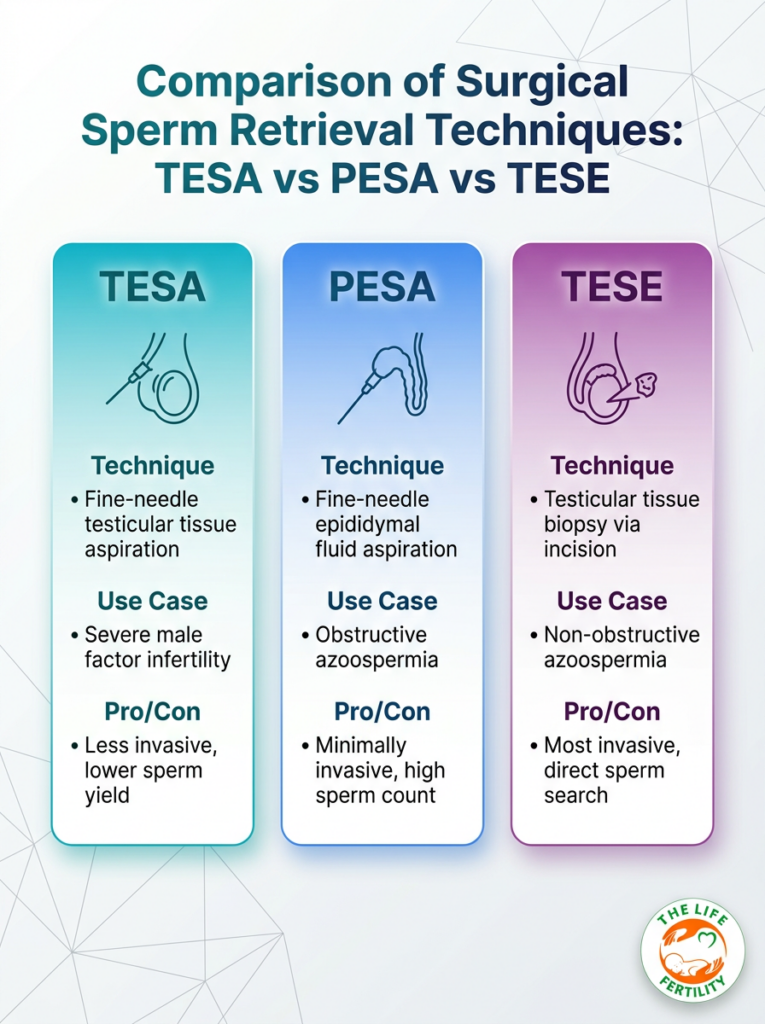
This infographic contrasts TESA, PESA, and TESE procedures used to retrieve sperm. It highlights when each method is most appropriate and provides a quick overview of their similarities and differences.
Micro-TESE requires specialized equipment and expertise only found in advanced male fertility centers. Our surgeons are trained in these microsurgical techniques to provide the best possible outcomes for our patients.
Preparing for Your Retrieval Procedure
Preparation begins with a detailed consultation to review your medical history and previous test results. We may recommend natural ways to become fertile through lifestyle changes before the surgery. Optimizing your health can sometimes improve the quality of sperm retrieved during the procedure. We provide clear instructions on fasting, medications, and what to bring on the day of your surgery.
It is important to have a support person available to drive you home after the retrieval. Our staff is always available to answer any questions you may have leading up to the procedure date.
Recovery and What to Expect After Surgery
Most men experience only mild discomfort following a sperm retrieval procedure. We typically recommend resting for a few days and avoiding heavy lifting or strenuous exercise. Any soreness can usually be managed with over-the-counter pain relief or ice packs. We provide a comprehensive aftercare guide to ensure your recovery is smooth and quick.
Most patients find they can return to their normal daily activities within 48 to 72 hours. Our team monitors your progress and is available for follow-up consultations if needed.
Combining Retrieval with Sperm Cryopreservation
Many patients choose to freeze a portion of the retrieved sperm for future use. This process, known as sperm cryopreservation, provides a safety net for future IVF cycles. Freezing sperm ensures that you do not have to undergo multiple retrieval surgeries if the first attempt at fertilization does not result in a pregnancy. This is a cost-effective and practical strategy for many couples.
Did You Know?
Men undergoing surgical sperm retrieval rated the procedure as significantly less painful than both vasectomy and vasectomy reversal (21% vs 42% vs 57% respectively).Our laboratory uses advanced freezing techniques to maintain the viability and health of the sperm. We securely store these samples in liquid nitrogen for as long as they are needed.
Genetic Testing and Embryo Selection
Once embryos are created using retrieved sperm, we can perform Preimplantation Genetic Testing (PGT). This allows us to screen embryos for chromosomal abnormalities before they are transferred to the uterus. PGT helps us select the healthiest embryos, which can improve the chances of a successful pregnancy. This is particularly valuable for couples with a history of genetic conditions or recurrent miscarriages.

In some cases where surgical retrieval is not successful, couples may explore options like donor embryo adoption. We provide support for all paths to building your family in 2026.
Choosing the Right Fertility Clinic for Your Journey
Selecting the right partner for your fertility journey is one of the most important decisions you will make. Our clinic combines world-class technology with a patient-centered approach to care. We provide transparent communication and evidence-based treatments tailored to your unique needs. Our success rates reflect our commitment to excellence and our passion for helping families grow.

Take the Next Step Toward Parenthood
If you are ready to take the next step, we invite you to contact us for a comprehensive evaluation. Together, we can build a plan that brings you closer to parenthood.
Book a ConsultationConclusion
Male infertility and surgical retrieval procedures have evolved significantly, offering hope to many who once faced very difficult odds. By utilizing techniques like TESA, PESA, and TESE, along with advancements like ICSI and PGT, we can address complex reproductive challenges with precision and care in 2026. We remain dedicated to providing you with the most advanced treatments and the compassionate support needed to navigate your path to a healthy baby. Through personalized diagnostic testing and specialized surgical expertise, we work to ensure that every patient has the best possible chance of success.