
What Really Happens During IVF in 2023? About 95,860 babies were born from 432,641 IVF cycles in the United States, which shows how many families worldwide are now relying on IVF and related procedures in 2026 to build their families. As a fertility clinic dedicated to bringing “smiles and completeness to families”, we know that understanding each part of the IVF journey can ease anxiety and help you feel more in control.
Key Takeaways
| Common Question | Short Answer |
|---|---|
| What are the main stages of IVF procedures? | IVF fertilises eggs outside the body, while IUI places prepared sperm directly into the uterus around ovulation. |
| How is IVF different from IUI? | ICSI may be used for male‑factor challenges or previous fertilisation problems, as explained on our Intracytoplasmic Sperm Injection (ICSI) page. |
| When is ICSI used during IVF? | Yes, some couples consider Preimplantation Genetic Testing (PGT) to analyse the embryos’ chromosomes or specific genetic conditions before transfer. |
| Can embryos be tested before transfer? | Yes, some couples consider Preimplantation Genetic Testing (PGT) to analyze embryo chromosomes or specific genetic conditions before transfer. |
| What if I need donor eggs, sperm, or embryos? | Our guides on Oocyte Donation, Sperm Donation, and Donor Embryo Adoption explain how donor options can be integrated into IVF procedures. |
| Can I freeze sperm or embryos for later IVF cycles? | Yes, we offer guidance on Cryopreservation (Sperm and Embryo Freezing) for future family planning. |
1. IVF Procedures Explained: What Really Happens During IVF In 2026
In 2026, IVF procedures are part of a broader group of assisted reproductive technologies designed to help individuals and couples who face infertility challenges. At our clinic, we describe IVF in simple terms, so you always understand what is happening at each stage.
IVF involves collecting eggs from the ovaries, combining them with sperm in a laboratory, monitoring resulting embryos, and then transferring one or more embryos into the uterus. Around these core steps, we build a personalised plan that takes your age, diagnosis, and family goals into account.
Our dedicated page on IVF procedures and treatments gives a structured overview if you prefer to read the steps in sequence. We are committed to explaining each option in a way that respects your values and culture.

2. Your First IVF Step: Consultation, History, and Fertility Testing
Every IVF journey at our clinic starts with an in‑depth consultation. We listen carefully to your story, previous treatments, and expectations, because no two fertility journeys are alike.
Fertility testing for IVF can include hormone tests, ultrasound scans, semen analysis, and sometimes additional investigations, depending on your unique situation. Our goal is to identify factors that may influence which IVF procedures are most suitable for you.
We then use these results to build a clear, written plan that explains medication timing, estimated number of clinic visits, and which laboratory techniques might be considered. This patient‑centred approach is part of how we strive for excellence in clinical outcomes and experience.

3. Ovarian Stimulation, Monitoring, and Egg Retrieval
Once we agree on a plan, IVF procedures usually begin with ovarian stimulation using injectable medications. The intention is to encourage the ovaries to develop several mature follicles, each potentially containing an egg.
Throughout this phase, you attend monitoring visits for ultrasound scans and blood tests. These help us adjust medication doses and choose the safest and most suitable time for egg retrieval.
Egg retrieval is a short procedure done under appropriate pain control or sedation. Using ultrasound guidance, we collect the follicular fluid that contains the eggs, which are then handed to our embryology team for careful assessment.

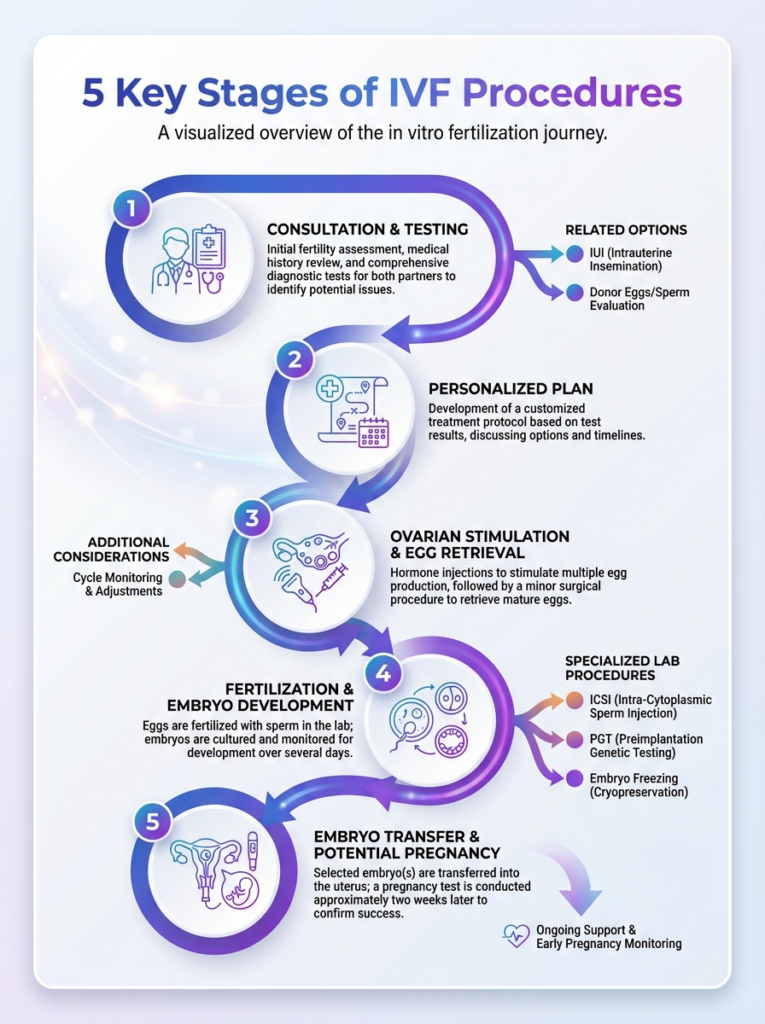
A concise guide to the five key stages of IVF procedures, from ovarian stimulation to embryo transfer. This infographic helps you quickly grasp the IVF process.
4. Fertilisation Methods: Conventional IVF vs ICSI
After egg retrieval, fertilisation can occur either through conventional IVF or Intracytoplasmic Sperm Injection (ICSI). In conventional IVF, prepared sperm are placed around each egg in a culture dish, and fertilisation is allowed to happen without direct injection.
Intracytoplasmic Sperm Injection (ICSI)
With ICSI, our embryologist selects a single sperm and injects it directly into an egg using delicate micromanipulation tools. According to our clinic information, ICSI may be considered in situations such as low sperm count, reduced motility, or previous fertilisation problems, among other indications.
We decide together which fertilisation approach aligns with your diagnosis and values. Our mission is to use the best of science, technology, and ethical practice while keeping your emotional well-being at the centre.
Did You Know?
UK data from 2023 show that around 52,400 patients had more than 77,500 IVF cycles, resulting in about 20,700 babies, while multiple births dropped to 3.4 percent as clinics increasingly focused on safer single embryo transfer policies.
5. Embryo Culture, Grading, and Preimplantation Genetic Testing (PGT)
Once fertilisation occurs, embryos are cultured in specialised incubators that mimic the conditions inside the body as closely as possible. During this time, our embryologists monitor development and document how each embryo progresses over several days.
Embryo grading is a laboratory way of assessing visual features like cell number and structure. Grading does not guarantee outcomes, but it helps us decide which embryos might be more suitable for transfer or freezing.
Preimplantation Genetic Testing (PGT)
PGT is an additional procedure some families consider during IVF. According to our PGT guide, it allows the laboratory to analyze embryos for specific genetic characteristics before transfer, which can include checking for certain inherited conditions or for chromosomal patterns.
PGT has benefits, limitations, and ethical questions, which we always discuss in detail. We do not promise specific outcomes, but we explain what current research and guidelines suggest, so you can make informed decisions that feel right for your family in 2026.

6. Embryo Transfer, Single Embryo Transfer Trends, and Luteal Support
Embryo transfer is a key IVF procedure that usually takes place either a few days after fertilization or at the blastocyst stage, depending on your treatment plan. A soft, thin catheter is passed through the cervix to place the selected embryo gently into the uterus.
In 2026, many clinics across the world encourage single embryo transfer where appropriate, to reduce multiple pregnancies while still aiming for strong success rates. This trend is reflected in international data sets that show high singleton birth proportions after IVF.
After transfer, medications such as progesterone are often used to support the uterine lining. While we cannot make guarantees, we guide you on what to expect in the two‑week wait and how to manage work, rest, and emotional support during this sensitive time.

Did You Know?
In 2023, IVF births made up about 2.6 percent of all births in the United States, showing how integral IVF procedures have become in helping families grow by 2026.
7. How IUI Fits Into the Bigger Picture of IVF Procedures
Although IUI is technically a different treatment, many families compare it with IVF when deciding how to move forward. Intrauterine Insemination (IUI) is less invasive, and for suitable cases, it can be tried before or alongside planning for IVF.
In IUI, specially prepared sperm are placed directly into the uterus close to the time of ovulation. This can sometimes be combined with mild ovarian stimulation, depending on your diagnosis and risk profile.
From our clinic’s perspective, the choice between IUI and IVF depends on factors such as age, sperm quality, tube status, and how long you have been trying to conceive. We explain calmly what each pathway involves and support you to weigh the emotional and financial aspects.
8. Donor Options Within IVF: Donor Eggs, Sperm, and Embryos
For some families, donor eggs, donor sperm, or donor embryos provide a hopeful path to parenthood when using their own gametes is not possible or advisable. In 2026, donor options are an integral and carefully regulated part of IVF practice in many countries.
Oocyte (Egg) Donation
Oocyte Donation involves using eggs donated by another woman. These donated eggs are fertilized in the laboratory, and the resulting embryos are transferred into the recipient’s uterus according to a coordinated IVF protocol.
Sperm Donation
Sperm Donation is another route that can be used for IVF or IUI. Donor sperm is obtained from screened donors, and our clinic materials emphasize eligibility, infectious disease screening, and counselling to ensure safety and emotional readiness.
Donor Embryo Adoption
With Donor Embryo Adoption, embryos created by another couple through IVF are donated to recipients. This option can be meaningful for those who cannot use their own eggs or sperm but wish to experience pregnancy and childbirth.
We are sensitive to the ethical, cultural, and emotional aspects of donor choices, and we encourage thorough counselling and reflection before you decide.
9. Cryopreservation: Freezing Sperm and Embryos For Future IVF Cycles
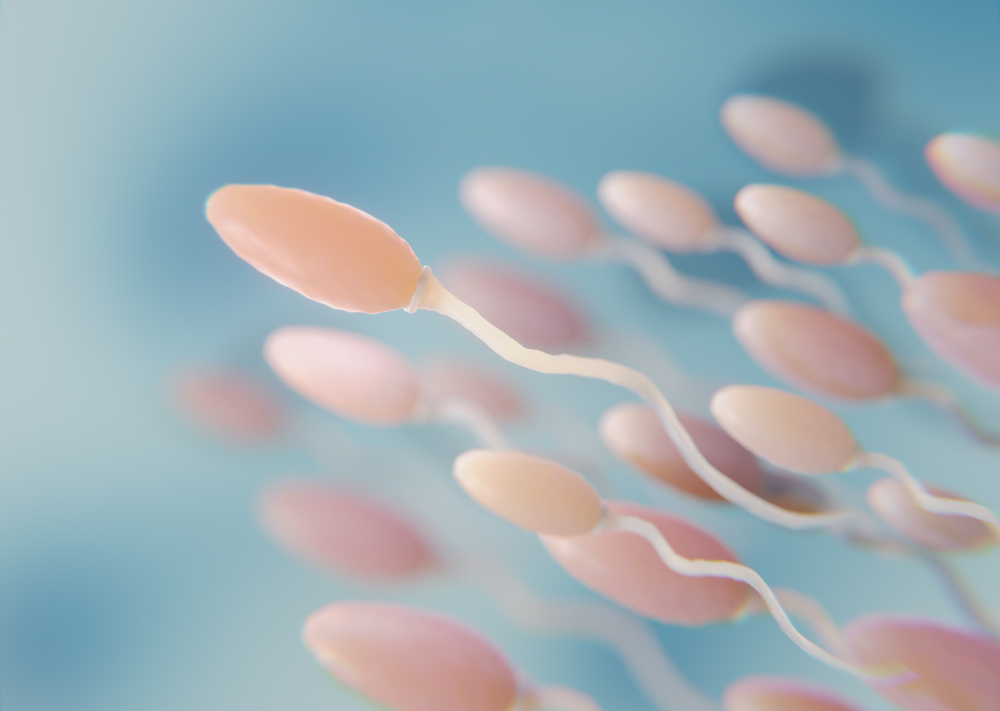
Cryopreservation (Sperm and Embryo Freezing) is an important part of modern IVF procedures in 2026. It allows individuals and couples to store sperm or embryos for future use, which can provide flexibility and reassurance.
Sperm freezing involves collecting and analyzing a sample before freezing it in liquid nitrogen for long term storage. This can be useful before medical treatments that might affect fertility, or to support multiple IVF cycles from one collection.
Embryo freezing happens after fertilization, once embryos reach a suitable stage in the laboratory. Freezing surplus good‑quality embryos means that, in future, you may not need to repeat all stages of stimulation and egg retrieval to attempt another transfer.
We explain storage arrangements, potential time frames, and consent requirements clearly, so you always know how your reproductive material is being cared for.
10. Additional IVF‑Related Procedures: Surgical Sperm Retrieval and More
Some IVF cycles require additional procedures to obtain sperm for fertilisation. Techniques such as TESA, PESA, or TESE involve retrieving sperm directly from the testis or epididymis in specific medical situations.
On our homepage, you will see these services summarised under TESA, PESA, and TESE as part of our comprehensive andrology support. These procedures are considered when ejaculated sperm are not available or are extremely limited.
We always coordinate closely between our fertility specialists and andrology team to plan timing around egg retrieval and laboratory schedules. In every case, our focus is on safety, clear communication, and preserving your future options as much as possible.
11. Emotional Support, Lifestyle Choices, and Next Steps After IVF Procedures
IVF procedures are medical and scientific, but the experience is deeply emotional. We recognise the stress, hope, and uncertainty that can accompany each appointment and each result, and we encourage you to seek counselling, peer support, and self‑care throughout.
Our articles on nutrition, stress management, and overall reproductive health provide practical tips that may complement clinical care, although they are not a substitute for personalised medical advice. We are careful not to claim that any particular lifestyle change will guarantee success, but we share evidence‑informed suggestions that you can discuss with your doctor.
Whether your current IVF cycle ends in pregnancy, freezing embryos, or planning another attempt, our team remains committed to walking beside you.
If you are ready to talk about your own IVF procedures overview in more detail, you can reach us through our Contact Us page to schedule a consultation.
Book a Consultation
Conclusion
In 2026, IVF procedures bring together science, compassion, and careful planning to help many families move closer to their dream of parenthood. From the first consultation to embryo transfer, donor options, and cryopreservation, each step can be tailored to your medical needs and personal values.
At The Life Fertility Clinic, our mission is to provide world‑class fertility care in a way that feels human, respectful, and hopeful. If you are considering IVF, we are here to answer your questions, explain every procedure in clear language, and support you as you decide the next right step for your family.