
If you are considering intrauterine insemination, it helps to know that large studies have found per-cycle pregnancy rates ranging from about 8 to 20 percent, depending strongly on age and specific clinical factors, so understanding practical IUI procedure tips in 2026 is more important than ever.
Key Takeaways
| Question | Short Answer |
|---|---|
| What is intrauterine insemination (IUI)? | IUI involves placing specially prepared sperm directly into the uterus around ovulation, as explained on our Intrauterine Insemination (IUI) page. |
| When is IUI usually considered? | Clinics may consider IUI for situations like mild male factor issues, unexplained infertility, or donor sperm use, which we position alongside other options in our IVF procedures and treatments overview. |
| How important is sperm quality for IUI? | Sperm testing, like the semen analysis topics in our male fertility resources, can guide whether IUI is a suitable option. |
| Can donor sperm be used with IUI? | Yes, many clinics combine donor sperm programs such as those discussed on our sperm donation page with IUI treatment plans. |
| How many IUI cycles do people usually attempt? | Research shows an average of a little over two cycles per patient in some cohorts, and our broader infertility library discusses how couples think about next steps. |
| Where can I read more about assisted reproductive options beyond IUI? | Our fertility articles and assisted reproductive technology service page outline how IUI fits with IVF, ICSI, PGT, and more. |
1. Understanding What Really Happens During an IUI Procedure
When you know the steps in advance, the IUI procedure usually feels more manageable and less stressful. We focus on explaining each stage clearly so you can walk into your appointment knowing what to expect and what questions to ask.
In general, IUI involves tracking ovulation, preparing sperm in the lab, and placing that prepared sample directly into the uterus using a thin catheter. This is different from intercourse, because the sperm are washed and concentrated and bypass the cervix to reach the uterine cavity more directly.
What IUI Is (And Is Not)
IUI is considered less invasive than IVF because fertilization still happens inside your body. Our own IUI overview describes it as a way to increase the number of sperm that can reach the fallopian tubes at the right time.
IUI is not a guarantee of pregnancy, and medical teams do not consider it suitable for every fertility situation. For example, if tubes are blocked or sperm counts are very low, other approaches can be more appropriate.
How IUI Compares With Other Fertility Procedures
IVF involves fertilizing eggs outside the body, then transferring embryos, as we outline in our IVF procedures and treatments guide. ICSI goes further by injecting a single sperm into an egg with micromanipulation tools.
By comparison, IUI keeps the process simpler and may be considered in situations where sperm can reasonably be expected to reach and fertilize the egg inside the body. Knowing these differences helps you discuss realistic expectations with your care team.
2. IUI Candidacy: When Clinics Commonly Consider This Option
One of the most useful IUI procedure tips is to start with a clear conversation about whether IUI fits your specific diagnosis. In 2026, many fertility clinics still look at similar criteria when recommending IUI, but they personalise decisions based on your history and test results.
We typically see IUI discussed when there is unexplained infertility, mild male factor issues, cervical factor concerns, or when using donor sperm. It can also play a role when regular ovulation induction is already part of your care plan.
Age and IUI: Why It Matters
Age is a central piece of the IUI conversation, because large cohort studies have shown that per cycle pregnancy rates tend to be higher in younger age groups and lower as maternal age increases. For example, one German cohort reported per cycle rates around 19.7 percent for those under 24, compared with lower percentages in later age brackets.
These numbers are averages from research settings, not promises of what will happen for you. They do illustrate why many clinics discuss timelines carefully, especially for people in their late 30s and early 40s.
How Other Factors Shape IUI Planning
Hormone patterns, semen analysis findings, tubal patency, and uterine health all influence whether IUI is reasonable. Our male fertility articles, for example, explain how semen analysis results can guide treatment choices.
Conditions like PCOS, when combined with ovulation induction, also appear frequently in IUI research, which is why many patients with ovulatory issues discuss IUI as one possible pathway with their doctors.
Thinking About Intrauterine Insemination?
Speak with our fertility specialists to understand your IUI procedure, timing, success rate, and the best treatment plan for you.
Book Your Consultation3. Preparing Your Body and Mind Before IUI Day
Preparation is not about guarantees; it is about giving yourself a structured, realistic plan around your IUI cycles. In 2026, that often means combining medical preparation with emotional and lifestyle considerations.
We encourage you to work closely with your care team on ovulation tracking, medication schedules, and any recommended blood tests or scans. At the same time, simple actions like organising your schedule, arranging transport, and planning time to rest can make procedure day calmer.
Cycle Tracking and Medication Routines
Many IUI cycles involve medication to stimulate or support ovulation, while others use natural cycles. Following your medication instructions carefully and noting any side effects for your doctor can help keep the cycle on course.
Monitoring, whether through ultrasound or blood work, gives your team timing information so the insemination can be scheduled as close to ovulation as possible. Clear communication about appointment times is a very practical IUI tip that patients often overlook.
Emotional Preparation and Support
Emotionally, IUI can bring hope and anxiety at the same time, especially when you know that per cycle pregnancy rates often sit in the single to low double-digit range. This mix of feelings is normal, and building a support system can make a real difference in how you experience the process.
Some people find it helpful to read broader context about infertility and stress, such as the pieces in our infertility category, then discuss coping strategies with their partner, friends, or a counsellor.

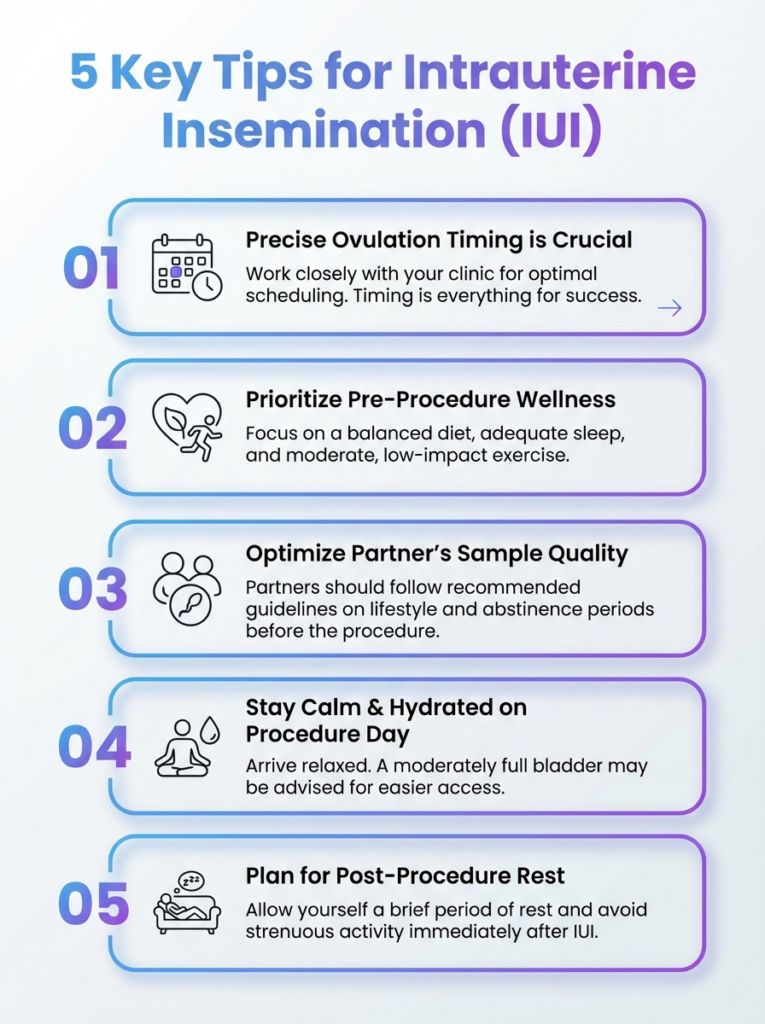
A quick visual guide to five essential tips for intrauterine insemination (IUI). Learn how to prepare, time, and track steps for better comfort and potential success.
4. IUI Timing Tips: Why “When” Often Matters As Much As “How.”
One of the most discussed IUI procedure tips in current research is timing. Since ovulation only offers a limited window for fertilisation, clinics often invest significant effort into getting the schedule as precise as possible.
Beyond ovulation timing itself, a French multicentre study suggested that the interval between the end of sperm preparation and the actual insemination, sometimes called TSP, may also matter. That study reported an optimal window of around 40 to 80 minutes in terms of clinical pregnancy outcomes.
Working With Your Clinic’s Timing Protocol
In practical terms, you can support timing accuracy by being punctual, reachable, and prepared for your IUI appointment. If your team adjusts the schedule based on a same-day ultrasound or hormone levels, try to stay flexible.
Writing your questions about timing in advance can help you understand what your clinic is aiming for. This way, if plans change, you know what factors might be driving that change.
Coordinating With Ovulation Induction or Trigger Shots
If your cycle involves a trigger injection, your team may schedule the insemination at a set number of hours after the shot. Clear instructions about when to take the trigger and what to do if you are late are essential.
Many couples also ask about intercourse timing around the IUI procedure, and clinics answer based on their own protocols and your medical situation. The key tip here is to ask early so you have a clear plan.
Did You Know?
One large analysis reported an overall intrauterine insemination pregnancy rate of 9.2% per cycle, which helps set expectations that many patients need more than one attempt.
5. Practical IUI Day Tips: From Arrival To Aftercare
On the day of your IUI, small practical steps can make the procedure feel smoother. We encourage you to think through transport, paperwork, and comfort in advance so you can focus on the experience, not logistics.
Arrive early, bring your identification and any required forms, and confirm when the sperm sample should be produced or delivered. If your partner is producing a fresh sample at the clinic, ask about any abstinence or collection instructions beforehand.
During the Procedure
The actual insemination is typically brief, often just a few minutes. You may feel some cramping or pressure as the catheter passes through the cervix, but many patients describe it as similar to a Pap smear in terms of sensation.
We usually recommend wearing comfortable clothing and asking your nurse or doctor to talk you through each step. Asking when you can expect to stand up or use the restroom afterward can also help you plan.
Have Questions About Your IUI Cycle?
Chat with our fertility team for guidance on intrauterine insemination timing, medications, and procedure preparation.
Chat on WhatsAppAfter the IUI: Immediate Tips
Most clinics allow patients to resume normal daily activities relatively quickly after an IUI, unless there are specific reasons to advise rest. Listening to your own body and asking your team for personalised guidance is wise.
Some spotting or mild cramping can occur after the procedure, and your clinic will tell you what they consider normal and when they would want you to call. Keeping a simple symptom log can help you remember details if you need to report them later.

6. Donor Sperm and IUI: Key Considerations in 2026
Donor sperm is a central topic in many IUI plans, especially for single parents by choice, same sex female couples, and heterosexual couples with significant male factor infertility. In 2026, there is growing research interest in how donor and partner sperm outcomes compare in IUI.
One 2024 study looked at cumulative live birth rates after IUI and reported higher cumulative outcomes with donor sperm than with partner sperm, particularly for people younger than 35. For example, in that age group, cumulative live birth rates were about 61.5 percent with donor sperm compared with about 27.6 percent with partner sperm, over multiple cycles in that specific dataset.
How Donor Sperm Programs Fit Into IUI
Our own sperm donation information explains that donor programs are carefully regulated. Screening aims to protect both donors and recipients and to provide transparent information about donor characteristics.
When donor sperm is combined with IUI, you and your team still need to consider age, uterine and tubal health, and other fertility factors. Donor sperm is one piece in the overall picture, not the only determinant of outcome.
European Registry Data and Donor IUI
Data from European registries have reported per-cycle delivery rates around 8.7 percent for partner IUI and about 12.1 percent for donor IUI in 2019. These registry figures again represent averages, not specific predictions.
For you, the practical tip is to discuss with your team whether donor sperm is an option and how it compares with other paths, such as IVF with ICSI, particularly if male factor infertility is a major part of the diagnosis
7. PCOS, Hormones, and IUI: Special Procedure Tips
Polycystic ovary syndrome, or PCOS, is a common diagnosis in fertility clinics, and many patients with PCOS consider IUI alongside ovulation induction. Recent research has focused specifically on this group to understand outcomes better.
One 2022 study that looked at PCOS patients undergoing IUI after ovulation induction reported a clinical pregnancy rate of about 22.4 percent per cycle and a live birth rate of around 17.8 percent per cycle, within that dataset. Cumulative clinical pregnancy and live birth rates per patient in the same study were higher than the per-cycle figures, because some patients conceived after more than one attempt.
Why Hormone Management Matters for PCOS and IUI
For PCOS, careful medication planning aims to encourage ovulation without overstimulation. That is why monitoring and follow-up are usually key parts of each IUI cycle in this context.
Our PCOS-focused resources explore hormone balance and fertility planning more broadly. In the IUI setting, the main tip is to ask regularly about how your hormone results are shaping the plan for each cycle.
Practical PCOS IUI Tips From Our Perspective
Keeping track of your cycle days, medication doses, and any side effects is especially helpful for PCOS patients, because your clinician may adjust doses across cycles. Using a dedicated notebook or app can reduce confusion.
Given that PCOS often links with metabolic and lifestyle factors, some clinics also advise specific nutrition and movement strategies. These are supportive elements rather than replacements for medical treatment, so they work best as part of a coordinated plan.
Did You Know?
In a large international cohort, donor sperm intrauterine insemination in people younger than 35 was associated with a cumulative live birth rate of about 61.5%, compared with about 27.6% when partner sperm was used, highlighting how sperm source can influence multi-cycle outcomes.
8. How Many IUI Cycles To Try: Setting Expectations
Many couples arrive at their first IUI cycle hoping that it will be the one. While that is always possible, research suggests that several cycles are often attempted before moving on or reassessing the plan.
One large German analysis reported that patients had an average of about 2.24 IUI cycles, with a range from 1 to 14. This wide range reflects how individualised decisions become as cycles progress.
Have Questions About Your IUI Cycle?
Chat with our fertility team for guidance on intrauterine insemination timing, medications, and procedure preparation.
Chat on WhatsAppDiscussing a Multi-Cycle Plan Upfront
A practical IUI tip is to ask your team, before you start, how many cycles they usually consider before revisiting the strategy. Some clinicians talk in terms of three to six IUI cycles, but recommendations vary with age and diagnosis.
Having a provisional roadmap reduces the sense of drifting from one cycle to the next. It also gives you a structure for reviewing what has been learned after each round of treatment.
Reviewing Each Cycle Objectively
After each IUI, your team can review whether the timing, follicle development, sperm prep, and lining all looked reasonable. Even if the test is negative, that information helps refine the next cycle or supports a decision to pivot to another approach.
This logic also applies to add-on procedures like preimplantation genetic testing in the IVF setting, which we explain on our PGT page. IUI does not include embryo testing, but the principle of using each cycle as data still holds.
9. When Clinics May Suggest Alternatives To IUI
Another important IUI procedure tip is to recognise when a different strategy might make more sense. This is not about giving up, it is about aligning treatment type with medical realities.
If repeated IUIs show similar patterns without pregnancy, or if new tests highlight additional issues, your clinician may suggest shifting to IVF, ICSI, or other assisted reproductive options. Our IVF and ICSI pages describe how these methods support fertilisation outside the body.
Male Factor Infertility and ICSI
In cases of very low sperm count or significant motility or morphology issues, ICSI often enters the discussion. ICSI involves injecting a single sperm directly into an egg in the lab, as we outline in our focused ICSI content.
In these situations, repeating IUI many times without adjusting the core strategy may not be the most efficient approach. Open conversations about male fertility test results can clarify this.
Donor Eggs, Donor Embryos, and Fertility Preservation
For some patients, either because of age or egg quality, options like donor eggs, donor embryos, or embryo freezing may be raised. We explain these in more detail on our oocyte donation and donor embryo adoption pages, as well as our cryopreservation overview.
These paths are deeply personal, and every couple or individual approaches them differently. The key procedural tip is to ask for time, space, and clear information before making any decision.
10. Emotional Health, Lifestyle Factors, and IUI in 2026
Finally, we see emotional and lifestyle support as integral parts of IUI care, not extras. In 2026, more patients are asking for holistic plans that acknowledge how stress, diet, sleep, and mental health interact with fertility journeys.
Research has examined links between stress and fertility, as referenced in our fertility and infertility content hubs, although the exact mechanisms remain complex. Regardless of the precise biology, many people find that managing stress improves their quality of life during treatment.
Building Your Support Network
Joining a support group, talking with a therapist experienced in fertility issues, or setting boundaries with friends and family around questions can all make a difference. The waiting periods before and after IUI can feel long, and structured support can help you navigate them.
Sharing accurate resources, such as our clinic homepage and dedicated service pages, with your close circle can also reduce misunderstandings. When people around you understand the process better, they are often better able to support you.
Realistic Hope, Not False Promises
Because per-cycle pregnancy and live birth rates for IUI sit in the single to low double digit range in many studies, we avoid offering guarantees. Instead, we focus on helping you understand your options, ask the right questions, and feel prepared for each procedural step.
That combination of realistic expectations and tailored medical care often helps patients feel more in control. Even when outcomes are uncertain, feeling informed and supported is something we can work toward together

Conclusion
IUI can be a meaningful part of a fertility journey, especially when you understand the procedure steps, timing considerations, and realistic outcome ranges that current research describes. In 2026, we see the most confident IUI experiences happen when patients combine clear medical information with practical preparation and emotional support.
As you consider intrauterine insemination, use these tips as a conversation starter with your fertility team. They know your medical details best, and together, you can decide how many cycles to attempt, when to reassess, and which additional options might support your path to building a family.