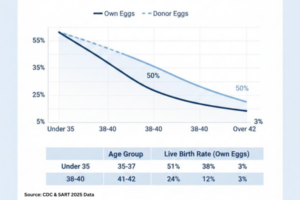


By 2026, research suggests that by age 40, more than 70% of a woman’s eggs may carry chromosomal abnormalities, which can strongly influence IVF outcomes and miscarriage risk. Understanding egg quality and the options available when it is reduced helps you and your care team plan more realistic and hopeful IVF strategies.
Key Takeaways
| Question | Answer |
|---|---|
| How does egg quality affect IVF success rates? | In 2026, the most evidence-based strategies still focus on optimizing your health, choosing the right protocol, considering ICSI, and using tools like PGT where appropriate. We summarize these in proven strategies to maximize IVF success rate. |
| Can egg quality be measured before IVF? | We cannot see everything that matters inside an egg, but tests such as AMH, antral follicle count, and your age give a useful estimate of egg supply, which links closely to egg quality. You can read more in our overview of factors affecting IVF success. |
| What are realistic ways to maximize IVF success in 2026? | In 2026, the most evidence based strategies still focus on optimizing your health, choosing the right protocol, considering ICSI, and using tools like PGT where appropriate. We summarize these in proven strategies to maximize IVF success rate. |
| Does using ICSI improve outcomes when egg quality is a concern? | ICSI can help when sperm issues make fertilization less likely, which protects precious eggs from being “wasted” on failed fertilization. Learn how we use ICSI within IVF cycles on our Intracytoplasmic Sperm Injection (ICSI) page. |
| What if my egg quality is very low? | If your own eggs are unlikely to lead to a pregnancy, donor options such as oocyte (egg) donation or donor embryo adoption can offer a different but very real path to parenthood. |
| Where can I learn general ways to boost my chances of pregnancy? | For lifestyle and planning advice that complements treatment, see our article on boosting pregnancy chances, which we update in line with current 2026 evidence. |
1. Why Egg Quality Is Central To IVF Success In 2026
When we talk about “egg quality”, we mainly mean how likely an egg is to have the correct number of chromosomes and enough energy to support early embryo growth. Poor quality eggs are more likely to lead to failed fertilization, embryos that stop growing, or embryos that look normal but carry genetic issues that prevent a healthy pregnancy.
In 2026, multiple research groups continue to show that egg quality is a primary driver of IVF success, particularly for women in their late 30s and 40s, so any plan to maximize success needs to place egg quality at the center. Our role as a clinic is to assess your individual situation, explain the limitations honestly, and still help you find the most hopeful and realistic path for your family.

Egg quality, age, and realistic expectations
Research suggests that egg quality tends to decline with age because the structures that keep chromosomes properly aligned become less reliable. This means that, even with perfect sperm and a state-of-the-art laboratory, some cycles will not result in a healthy embryo ready to transfer.
2026 outcome data from fertility centers worldwide still show a clear difference between age groups, with higher birth rates per transfer for younger patients compared with women in their early 40s. Our goal is not to discourage you, but to explain this pattern so that every decision you make is informed and empowered.
Egg quality versus egg quantity
Egg quantity, or ovarian reserve, affects how many eggs we can usually retrieve during IVF, while egg quality influences how many of those eggs can become healthy embryos. Both matter, but they do not always move together, and we sometimes see women with low reserve but relatively good quality eggs for their age.
When we review your tests during an IVF consultation, we look at both sides together, then recommend whether standard IVF, IVF with ICSI, or an alternative like egg donation is likely to give you the best chance in your situation.
2. What Science Currently Shows About Egg Quality And Embryo Development
Several studies published up to 2025 continue to explore how egg quality shows up in embryo development during IVF. One important pattern is that eggs which initially form good quality day 3 embryos are more likely to reach the blastocyst stage, which is usually the point when we either transfer or freeze an embryo.
In one study, about 53.6% of good-quality day 3 embryos reached the blastocyst stage compared with 19.3% of poor-quality day 3 embryos. This suggests that early embryo appearance, which reflects both egg and sperm factors, can give some guidance on the number of embryos likely to be available for transfer or genetic testing.
Euploid embryos and why they matter
An embryo with the correct number of chromosomes is called euploid, and these embryos are more likely to lead to a successful pregnancy. In one study of 847 couples undergoing preimplantation genetic testing for aneuploidy, about 33.6% of tested blastocysts were euploid, and roughly 40.1% of couples had at least one euploid embryo.
These numbers highlight why patients may need to go through more than one IVF cycle to obtain a euploid embryo, especially as age increases. They also show why egg quality is not only about creating embryos, but about creating embryos with the best chance of leading to a healthy baby.
Why egg quality is not the only factor
Even with a euploid embryo, not every transfer leads to pregnancy, because uterus receptivity, hormonal balance, and other medical factors also play a role. This is why we always talk about egg quality as one key piece of a larger puzzle, not as a guarantee of outcome.
In 2026, research continues on laboratory additives and supplements that might support eggs and embryos, but many of these approaches remain under investigation, so we discuss them carefully and avoid presenting unproven approaches as confirmed solutions.
3. Emerging Egg Quality Research In 2026: Hopeful, But Still Early
Scientists are actively exploring new ways to support egg quality, particularly in older women, and some early studies look promising. For example, in a preclinical study involving more than 100 human eggs from women aged 22 to 43, one treatment increased the proportion of viable eggs from about 47% to about 71% in laboratory conditions.
Another experimental approach that has attracted attention involves a protein called Shugoshin 1, which helps keep chromosomes correctly attached inside the egg, and early work suggests that treating eggs with this protein in a lab setting reduced chromosomal errors in the resulting eggs.

Why can we not promise results from experimental methods
It is important to understand that these studies are at an early stage and mostly carried out on eggs in research laboratories, not in routine patient treatment. They show what might be possible in the future, but they do not yet prove that the same benefits will appear in real world IVF cycles for patients in 2026.
As a clinic that values both science and ethics, we monitor these developments closely, but we avoid presenting such methods as standard treatment options until there is stronger clinical proof from well-conducted human trials.
Managing expectations about “egg quality boosters.”
You may see claims online in 2026 about supplements, injections, or “treatments” that claim to dramatically improve egg quality or reverse age related decline. At present, there is not enough robust clinical evidence to support most of these strong claims, especially those promising large improvements in success rates in older age groups.
We can discuss potential benefits and limitations of different approaches with you, but we prefer to base our guidance on data from controlled clinical studies rather than on marketing messages or very small pilot studies.
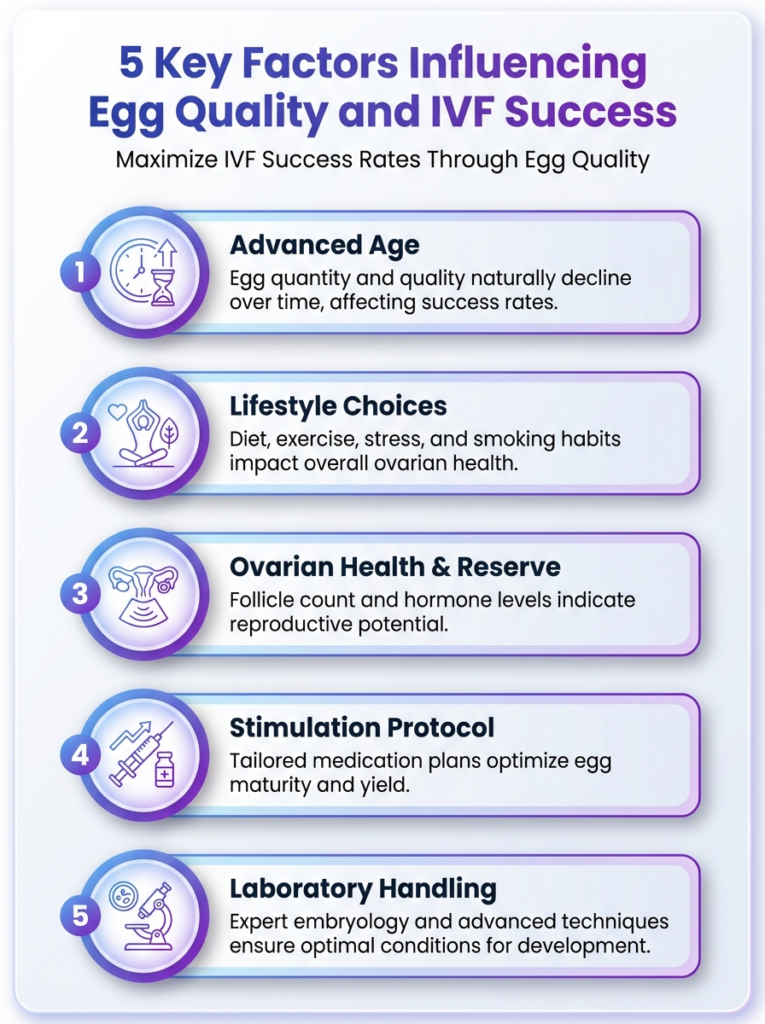
This infographic highlights five key factors affecting egg quality and IVF outcomes. Learn practical steps to improve success rates.
Did You Know?
Treating eggs with Shugoshin 1 in early studies reduced chromosomal defects from about 53% in untreated eggs to about 29% in treated eggs, highlighting how directly targeting egg structures might help in the future, although this is not yet a standard clinical option.
4. Standard IVF Procedures And Treatments That Protect Egg Potential
Even without experimental methods, the way an IVF cycle is designed in 2026 can support the potential of your eggs. Careful stimulation protocols aim to recruit multiple eggs in one cycle while still protecting your safety, and timing of the trigger injection and egg collection is crucial for retrieving mature eggs that are ready for fertilization.
Our overview of IVF procedures and treatments describes how we move from the first consultation, through ovarian stimulation and egg retrieval, to fertilization and embryo transfer, always with the goal of treating every egg as precious.

Why ICSI can be important when eggs are limited
In Intracytoplasmic Sperm Injection, or ICSI, our embryologists choose a single sperm and inject it carefully into each mature egg using micromanipulation tools. This helps overcome many sperm related issues that might otherwise prevent fertilization from happening.
When egg numbers are low, or when you have already been through unsuccessful cycles, ICSI can reduce the risk of having a cycle where eggs fail to fertilize because of sperm problems, which is particularly important when each egg has extra emotional and practical value.
The role of freezing in making the most of each good egg
Eggs themselves are more delicate to freeze and thaw than embryos, but embryo freezing is now an established tool that lets us store good quality embryos for later use without repeated stimulations. This can be particularly useful if a first transfer fails or if you want to consider another child in the future.
Our cryopreservation service is designed to maintain embryo quality as much as current technology allows, so that the effort and emotion that went into each cycle continues to serve you in the months and years that follow.
5. Preimplantation Genetic Testing (PGT) And Egg Quality
Preimplantation genetic testing in 2026 is mainly used to screen embryos for chromosomal abnormalities or specific inherited conditions before transfer. This does not change egg quality, but it can help us see the results of egg and sperm quality more clearly by showing which embryos are chromosomally normal.
On our PGT information page, we explain how this testing can reduce the chance of transferring an embryo with a known genetic issue in certain situations, and what the limitations of testing are.
PGT and realistic expectations around success rates
PGT can help us prioritize which embryo to transfer first, particularly for older patients with several blastocysts or for couples at risk of passing on a specific disease. However, even a euploid embryo is not a guarantee of a healthy pregnancy, and testing does not create more good embryos if egg quality is already limited.
Some clinics and articles suggest that certain lab treatments might multiply IVF success rates when combined with PGT, especially for women aged 35 to 45, but at present, these figures are usually projections or modelled estimates rather than robust clinical proof, so they should be viewed with caution.
How do we decide whether PGT is suitable?
We consider your age, your history of miscarriage or IVF failure, your family history, and the number of embryos expected when deciding whether PGT might be worth considering. For some couples, especially those who are younger with only a few embryos, the additional cost and the biopsy process may not be justified by clear evidence of benefit.
For others, especially those with a known inherited condition, PGT can provide reassurance that a transferred embryo does not carry that specific condition, which can be deeply meaningful in their family planning journey.
6. Oocyte (Egg) Donation When Egg Quality Is A Major Limiting Factor
For some women, particularly in their 40s or with certain medical conditions, the chances of a successful IVF cycle using their own eggs can be very low. In these situations, oocyte donation offers another path, using eggs from a younger donor who has met strict health and screening criteria.
On our oocyte donation page, we outline who egg donation is usually for, how we select donors, and what the step by step process looks like for recipients.
Why donor eggs often change the outlook
Donor eggs usually come from women in a younger age group, so the egg quality is typically higher, with fewer chromosomal abnormalities and better energy reserves. This can give a very different prognosis compared with repeated cycles using your own eggs at an older age, although individual results always vary.
We never push patients toward donation, because the emotional and spiritual aspects are deeply personal, but we do present it honestly as one of the most effective options for those whose own egg quality makes standard IVF very unlikely to succeed.
Navigating the emotional side of egg donation
Choosing egg donation means adjusting to the idea of parenting a child who will not share your genetic material, and for many women this brings understandable grief alongside hope. We encourage open conversations, counselling where helpful, and time to reflect on what family and motherhood mean to you beyond biology.
Many parents later describe donor egg IVF as a miracle that came through both faith and science, and children born from donor eggs are fully and deeply their own, regardless of genetics, which is what truly matters in the long term.
7. Donor Embryo Adoption As Another Path To Parenthood
Embryo adoption, or donor embryo treatment, is another option when both egg and sperm quality are limiting factors, or when other treatments have been unsuccessful. In this approach, embryos created by another couple through IVF are donated to recipients who then carry the pregnancy.
Our donor embryo adoption guide explains the process from matching to transfer, and how we support both donor and recipient families through this very special decision.
How embryo adoption relates to egg quality
In practical terms, embryo adoption means that the egg quality question was already addressed in the original IVF cycle that created the embryos. If those embryos were created from younger eggs or from screened donors, they may have a higher likelihood of being chromosomally normal compared with embryos you might create yourself at an older age.
However, as with all reproductive options, outcomes are not guaranteed, and success depends on factors such as the age and health of the original egg provider, how the embryos were created and stored, and your own uterine health.
The spiritual and ethical dimensions
For many of our patients in Nigeria and beyond, embryo adoption has a strong spiritual meaning, as they see it as welcoming a life that was already created but still waiting for a family. We respect the ethical questions that can arise and offer space to talk through them in a compassionate, non-judgmental way.
Families who choose this path often describe their stories as testimonies of hope and grace, where advanced reproductive technology meets the deepest kind of love and commitment.
Did You Know?
In a large study, about 33.6% of tested blastocysts were chromosomally normal (euploid), and roughly 40.1% of couples had at least one euploid embryo, underlining why some patients need more than one IVF cycle to find a suitable embryo for transfer.
8. Practical Steps You Can Take To Support Egg Health Before IVF
While we cannot fully “fix” age related egg changes, some practical steps may support overall reproductive health and, indirectly, egg potential. In 2026, guidelines still emphasize avoiding smoking, moderating alcohol, maintaining a healthy weight, and managing long term conditions like diabetes or thyroid disease as part of fertility care.
Good sleep, stress management, and a balanced diet with adequate protein, healthy fats, and micronutrients also support general health, which is important for both egg development and how your body handles fertility medications.
Being cautious with supplements and off-label treatments
Many supplements are marketed to “boost egg quality” in 2026, but the strength of evidence for specific products varies widely, and some may interact with fertility medications. It is important to review anything you plan to take with your fertility specialist, rather than relying solely on online reviews or advertisements.
We are happy to discuss what current research suggests, and where the gaps in knowledge remain, so that you do not feel pressured into expensive regimens that have not been shown to improve IVF success in well-designed studies.
Timing and planning your IVF cycle
Starting IVF earlier in your reproductive timeline, when possible, usually means working with eggs that still have relatively better quality for your age group. We know that life, finances, and personal readiness all play a role, so we do not simply say “hurry up”, but we do encourage early assessment if you think you may need help to conceive.
By talking with us sooner, you can understand your ovarian reserve, discuss options like embryo freezing, and plan a path that respects both your present circumstances and your future family hopes.
9. How We Personalize IVF Plans Around Egg Quality
At The Life Fertility, we do not believe in one-size-fits-all fertility care, particularly when egg quality is a key concern. During your first IVF consultation, we review your medical history, previous pregnancies or losses, hormone tests, ultrasound findings, and partner factors in detail.
We then discuss realistic scenarios for your age and egg reserve, explain the likely number of eggs we might aim for in a cycle, and talk through the pros and cons of adding options like ICSI or PGT based on your situation, not as automatic add-ons.
Balancing hope and honesty
We know that many of our patients arrive with a mixture of faith, fear, and exhaustion, especially if they have already been disappointed in other clinics. Our commitment is to communicate clearly, so you understand where egg quality is likely to help or limit the outcome, while still holding space for the possibility of a positive surprise.
In some cases, that honesty leads to the difficult conclusion that options like donor eggs may be more suitable than more cycles with your own eggs, and in others it leads to a renewed sense of hope that IVF with your own eggs is worth pursuing.
Continuous review with each cycle
Every IVF cycle also gives us more information about how your eggs respond and how your embryos develop. We use this feedback to adjust medication doses, stimulation schedules, or adjunct procedures in subsequent cycles, always aiming to make the most of what we have learned from your body.
This ongoing refinement respects the emotional and financial investment you are making and reflects our mission to continually strive for excellence in clinical outcomes while staying deeply compassionate.
10. When To Consider Alternatives To IVF With Your Own Eggs
There is a point for some women where continuing IVF with their own eggs may bring more distress than benefit. Indicators might include repeated cycles with very few eggs retrieved, consistent failure to reach blastocyst, or repeated abnormal PGT results that suggest a very high rate of chromosomal issues.
At that stage, we gently raise the possibility of other paths such as oocyte donation, donor embryo adoption, or sometimes considering adoption outside of medical treatment, depending on your personal values and resources.
Making a decision you can feel at peace with
These decisions are never purely medical, and we do not see them as “giving up”, but as choosing the path with the greatest chance of bringing a child into your life in a way that aligns with your heart and faith. Some couples feel called to keep trying with their own eggs despite low odds, while others sense that God is opening a different door through donation or adoption.
Our team stands beside you, whichever direction you take, offering clear information, gentle guidance, and ongoing support so that you do not feel alone in the process.
Using information, not fear, to guide your journey
In 2026, information about IVF and egg quality is everywhere, and some of it can be frightening or confusing. We encourage you to bring your questions to us, so we can help you separate evidence-based guidance from speculation or marketing-driven claims.
Knowledge about egg quality should not steal your hope, but instead help you channel it toward the options that are most likely to bring the family you long for closer to reality.
Conclusion
Egg quality is a crucial part of IVF success, but it is not the only part, and it is not a verdict on your worth or your future as a parent. In 2026, science continues to deepen our understanding of how eggs age and how embryos develop, while new experimental treatments are being explored with care and caution.
At The Life Fertility, we combine this evolving science with compassionate, patient-centered care, so that every test, protocol, and decision is shaped around your story, your faith, and your dreams of holding a child in your arms. If you are ready to talk through your own egg quality and IVF options, we would love to speak with you and walk this journey together.